Save 20% on all ebooks
The Augmented Plant: How AI Will Redefine Operational Excellence
AI is shifting operational excellence from reactive to predictive — McKinsey finds AI-driven predictive maintenance can cut downtime up to 50% and extend asset life up to 40%. Yet only 5.5% of companies see real ROI. Here’s a clear-eyed POV on what changes, what stays human, and how to be on the winning side.
AIFACTORYOPERATIONAL EXCELLENCE
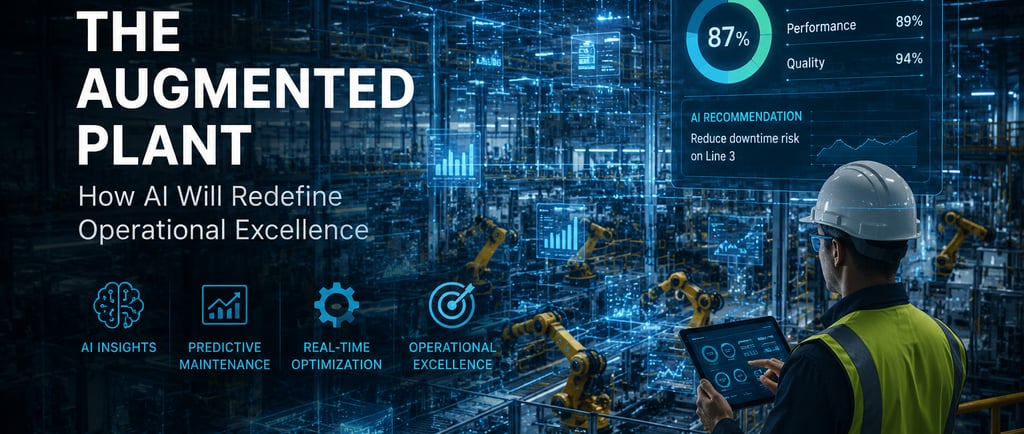
For decades, operational excellence has been a discipline of disciplined humans — people trained to observe, measure, and steadily eliminate waste. That foundation isn’t going away. But artificial intelligence is about to change what’s possible at every layer of it, shifting operational excellence from a reactive, periodic effort into something continuous, predictive, and self-correcting.
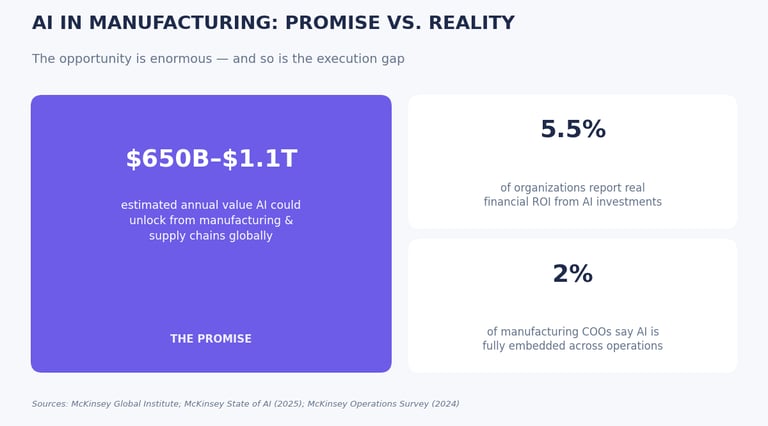
The scale of the opportunity is striking. McKinsey Global Institute estimates that nearly a quarter of generative AI’s global value — roughly $650 billion to $1.1 trillion — originates from manufacturing and supply chains. But there’s an equally important counterweight: McKinsey’s 2025 State of AI research found that only 5.5% of organizations are seeing real financial returns from their AI investments, and a survey of 100+ manufacturing COOs at billion-dollar companies found just 2% have AI fully embedded across operations. The promise is enormous. The execution gap is the story.
This is a point of view on how AI will reshape operational excellence — and what it takes to be on the right side of that gap.
From hindsight to foresight
Traditional improvement looks backward. You collect data, analyze last month’s performance, find the problem, and act. AI compresses this loop dramatically. By learning from streams of real-time data, AI systems can flag a developing problem before it becomes a stoppage — recognizing the subtle patterns that precede a machine failure or a quality drift long before a human would notice them.
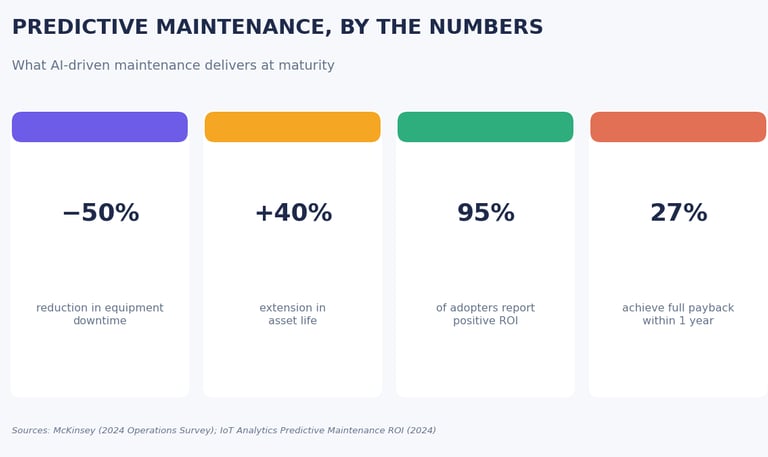
The numbers behind this shift are now well-documented. McKinsey research indicates that AI-driven predictive maintenance can reduce equipment downtime by up to 50%, cut maintenance costs by 10–40%, and extend asset life by as much as 40%. Deloitte analyses point even higher in mature deployments — up to 70–90% reductions in unplanned downtime. Crucially, the ROI is no longer theoretical: IoT Analytics reports that 95% of predictive maintenance adopters see positive ROI, and 27% achieve full payback within a single year. Operational excellence stops being about reacting faster and becomes about not needing to react at all.
Waste elimination that never sleeps
The human eye is powerful but limited. It can’t watch every machine, every shift, every variable simultaneously. AI can. It continuously monitors the gap between how a process should run and how it actually runs, surfacing losses that would otherwise hide in the noise.
This matters because the baseline is poor. The global average OEE sits at just 55–65% against an 85% world-class standard, and only about 3% of manufacturers sustain top-tier performance. Much of that gap is invisible, low-grade loss — minor stops, micro-slowdowns, small quality variations — exactly the kind of pattern AI excels at detecting at scale. Reported results bear this out: 78% of production facilities using AI report measurable waste reduction, and AI-driven energy management systems deliver average energy savings of around 12%. The professional’s role shifts from hunting for waste to deciding which AI-surfaced opportunities matter most and acting on them with judgment AI doesn’t have.
Decisions at the speed of the line
Much of operational excellence is decision-making under pressure: how to schedule, where to allocate, when to intervene. AI excels at navigating these complex trade-offs in real time — balancing demand, capacity, and constraints faster than any planner working with spreadsheets. The result isn’t a plant that runs itself, but one where the people running it are equipped with options and predictions instead of guesses.
The competitive consequences are already visible. Manufacturers in McKinsey’s Global Lighthouse Network — the recognized leaders in advanced production — are estimated to be three to five years ahead of their competitors on the adoption curve. The gap compounds: early movers report meaningfully lower cost structures, and that advantage widens every quarter a laggard waits.
Knowledge that no longer walks out the door
One of manufacturing’s quiet crises is the loss of expertise when experienced people retire. AI offers a partial answer: it can capture patterns from decades of operational data and make that accumulated wisdom accessible to a new operator on day one. The hard-won intuition of veterans becomes a resource the whole organization can draw on, rather than something tied to individuals. As maintenance shifts from manual judgment to data-and-AI-assisted decision-making, the teams that document and digitize their expertise turn it into a durable asset instead of a retirement risk.
What stays human
It would be a mistake to imagine AI replacing the discipline of operational excellence. AI sees correlations; it doesn’t understand purpose. It can recommend, but it can’t take responsibility. It has no instinct for the political, cultural, and human dynamics that determine whether an improvement actually takes hold on the floor.
This is precisely why the ROI gap is so wide. McKinsey’s own conclusion is that the companies pulling ahead aren’t simply using better tools — they’re running fundamentally better workflows, with modernized data architecture as the prerequisite. AI deployed on top of messy data, siloed systems, and disengaged teams produces dashboards, not results. The professionals who thrive will be those who pair AI’s pattern-recognition with their own judgment, context, and ability to lead people through change.
The new operating model
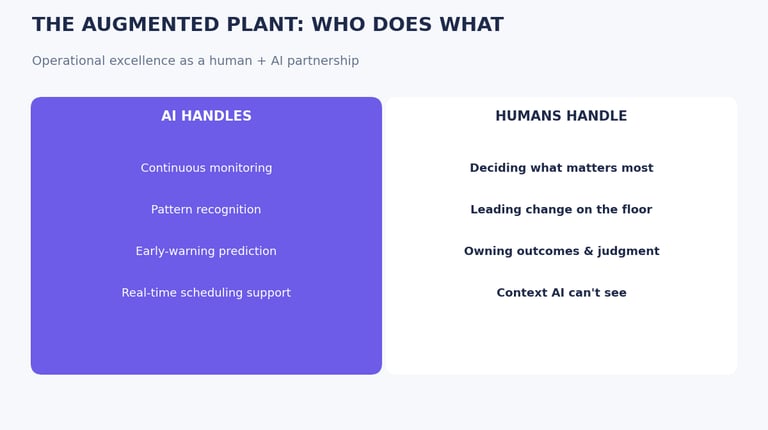
The plant of the near future is best understood as augmented rather than automated. AI handles the relentless work of watching, measuring, and predicting. Humans handle the work of deciding, prioritizing, and persuading. Operational excellence becomes a partnership.
For professionals, the strategic takeaway is clear. The fundamentals — seeing waste, measuring honestly, fixing root causes — don’t become obsolete; they become the foundation AI is built on top of. The difference is that those who learn to work alongside these systems, rather than fear them, will define the next era of how things get made. The 5.5% who are already winning prove it’s possible. The question is no longer whether AI will redefine operational excellence, but who will be ready when it does.
Sources: McKinsey State of AI (2025) and Operations Survey (2024); McKinsey Global Institute generative AI value estimates; Deloitte and Mordor Intelligence predictive maintenance analyses; IoT Analytics predictive maintenance ROI (2024); Evocon and Symestic OEE benchmark studies; McKinsey Global Lighthouse Network research.
Brand
Explore our sleek website template for seamless navigation.
Contact
Newsletter
© 2024. All rights reserved.